
Disaster Incubation
Revisiting Some Classics

I’m participating soon in a meeting about schools and crisis management hosted by Lora Barlett at UC Santa Cruz. To prompt discussion between crisis management and education researchers, Lora asked me to provide a short introduction to “disaster incubation.” So I dug back into some of the classic work on the topic.
What’s in a word? “Incubation” points to how something is generated over a period of time through a developmental process. In his classic, Man-Made Disasters (1978), Barry Turner coined the term “disaster incubation” to suggest that disasters arise through an interaction of cognitive and sociological factors.
More profoundly, perhaps, “disaster incubation” implies that disasters develop through an interaction and accumulation of factors that are not receiving our full attention. These factors are not necessarily hidden or completely unacknowedged, but they operate in a context of neglect or fatalism.
Turner asks “What stops people from acquiring and using appropriate advance warning information so that large-scale accidents and disasters are prevented? (Turner 1978, 162). His answer, nicely summarized by Anthony Hopkins, is that “1) The information is completely unknown…2) Information is noted but not fully appreciated…3) Prior information is not correctly assembled…4) Failure to pass bad news up the line to senior managers..and 5) There is no place for the information in existing categories” (Hopkins, 2021, 20). Disasters incubate because both collective awareness and collective action are slipshod.
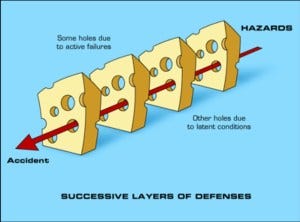
In Human Error (1990), James Reason took this analysis of disaster incubation a step further. He argues that accidents rarely arise from the unilateral error of a single operator, but rather from a concatenation of slips, lapses, mistakes and violations. These are both “active” and “latent.” He associated active errors and violations with the traditional understanding of operator error. However, he associated latent errors with organizational and managerial processes. These errors are particularly concerning because they often persist undetected in organizations.

Reason synthesized these ideas in his famous “swiss cheese” model, which conceptualizes how active and latent errors and violations align to defeat accident safeguards.
In Drift into Failure, Sidney Dekker credits Turner’s model of disaster incubation with opening up an important line of inquiry, but criticizes both Turner and Reason as too “Newtonian” (pp. 58, 87). By “Newtonian,” he means they are still too mechanistic and reductionist, leading them to focus too much on the “broken component” that triggered the accident.
Dekker argues for a more systemic view of accidents that he calls “drift.” Drawing inspiration from complexity theory, he points out that organizations are open systems that must juggle multiple objectives and demands. Adapting to these shifting demands and priorities can lead them to “drift” away from standards and processes that might guarantee safety.
A related account of drift was developed by Scott Snook (2000) in his insightful account of a tragic “friendly fire” incident in northern Iraq. After analyzing the “broken components” that led to the incident, Snook argues that this analysis fails to fully capture a holistic understanding of the accident.

Snook argues that “drift” provides the missing holistic theoretical perspective. Drift occurs when different groups develop strategies and processes based on successfully repeated practices that are locally-efficient for them but in conflict with more global standards or practices.
Although Diane Vaughan (1996) does not use the concept of incubation or drift in her magisterial study of the Challenger Shuttle accident, she does develop an analogous perspective she calls “the normalization of deviance," which is related to how groups gradually produce work cultures that accept, ignore or overlook certain risks. These assumptions about risk are, in turn, legitimated by professional or managerial cultures that set standards for knowledge and decisionmaking and reinforced by the compartmentalization of information (“structural secrecy”).
Whether you label it incubation, swiss cheese, drift or normalization of deviance, these classics provide insights into how disasters gestate within and between organizations.
Chris Ansell, Director, Center for Catastrophic Risk Management

References
Dekker, S. (2011). Drift into failure: From hunting broken components to understanding complex systems. CRC press.
Hopkins, A. (2021). Turner and the Sociology of Disasters. In Inside Hazardous Technological Systems (pp. 19-32). CRC Press.
Reason, J. (1990). Human Error. Cambridge University Press.
Reason, J. (2000). Human error: Models and management. BMJ, 320(7237), 768-770.
Snook, S. A. (2000). Friendly fire: The Accidental Shootdown of US Black Hawks over Northern Iraq. Princeton University Press.
Turner, B. (1978). Man-Made Disasters. Wykeham Publications.
Vaughan, D. (1996). The Challenger Launch Decision: Risky Technology, Culture, and Deviance at NASA. University of Chicago Press.
Really solid synthesis of Turner through Dekker. The move from "broken components" to drift feels crucial becuase it shifts focus from isolated failures to system-wide adaptation patterns. Saw this play out in a hospital network I consulted for where every department optimized locally for efficiency, but nobody caught how those local wins were creating massive coordination gaps. Turner's point about info not fitting existing categories probaly explains why orgs keep repeating the same disasters with slightly different variables.
Very thoughtful discussion, Chris. This concept also aligns with the concept of social entropy, often attributed to the depletion of energy in an organization (or social system) through complacency and fading attention. Clearly failures are accumulating, but also attention is declining. The question is which is more detrimental to maintaining reliable performance.